Triangle counting acceleration accepted by IEEE TC: from graph algorithms to in-memory architecture
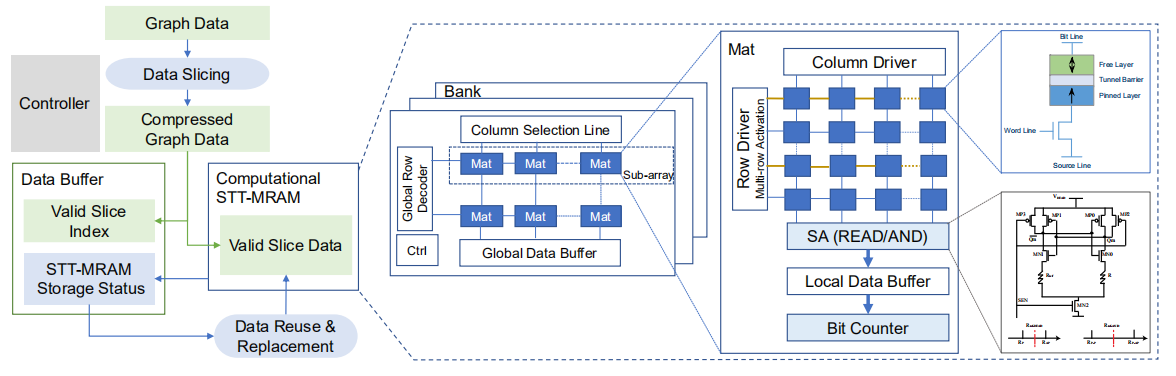
👏 Paper title: Triangle Counting Accelerations: From Algorithm to In-Memory Computing Architecture.
This work studies triangle counting, a core graph analytics primitive used to measure graph clustering and local connectivity. Because triangle counting repeatedly intersects neighbor sets and moves large graph data structures through the memory hierarchy, conventional CPU-centric execution can be dominated by memory traffic rather than arithmetic.
The paper develops an acceleration path from algorithm design to processing-in-memory architecture. By moving key operations closer to memory and reorganizing graph computation around data locality, the proposed design reduces unnecessary data movement and improves the efficiency of triangle counting for large graph workloads.
The work is positioned as an end-to-end acceleration study rather than a single hardware tweak. It considers how graph representation, intersection behavior, and memory access patterns interact, then maps the dominant operations onto an in-memory computing substrate.
This kind of co-design is valuable for graph workloads because arithmetic is often not the only bottleneck. By reducing traffic across the memory hierarchy, the architecture can improve throughput and energy behavior for triangle counting and related graph mining tasks.